How our platform carried the project’s social robotics testbed from concept to evaluation
Robots are getting better at doing tasks. The harder question is whether they can understand what they are doing, and whether they can make that understandable to the people around them. That was the starting point of CoreSense, a four-year Horizon Europe project that has now come to a close.
Over those years, the consortium built a theory of awareness for autonomous robots and turned it into a hybrid cognitive architecture and an open-source, ROS-compatible toolbox. The approach relies on explicit models of what a robot knows about itself, its tasks and the objects it handles. Engineers write these models and hand them to the robot directly, so there is no need to retrain it for every new situation. The result was tested in three settings: manufacturing, drone inspection and social robotics.
Where TIAGo came in
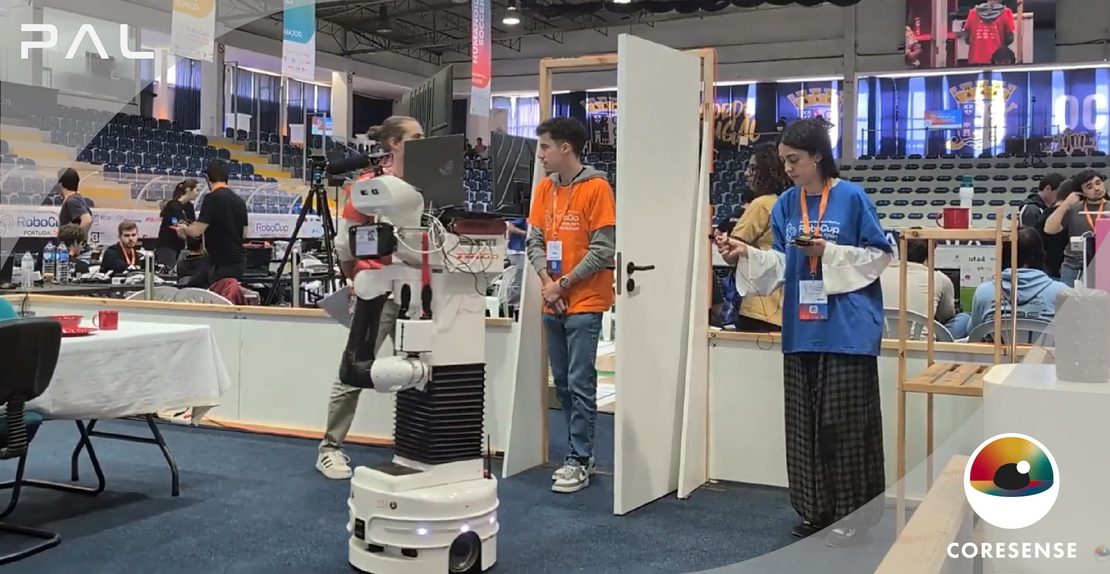
PAL Robotics took the lead on the Social Robots Testbed, and TIAGo was the platform on which it was finally deployed and evaluated.
The scenarios were inspired by RoboCup@Home: welcoming guests, showing them to a seat and taking their belongings. These are everyday tasks, and they are demanding precisely because people are involved. On TIAGo, the robot activated its audio and vision modules according to what each situation required, and used the HEXAR explainability module to communicate its internal state through voice and gestures. In practice, this meant that people could follow what the robot was doing and why.
This is the kind of work our platforms are built for. After 20 years designing and building robots, we know that real value appears when a robot leaves the lab and works alongside people. CoreSense gave TIAGo the chance to show that, and to do it with a robot that can explain itself.
The explainability research behind this work received the Best Paper Award in the Human-Robot Interaction category at ICRA 2026. The HEXAR and RoboCup demo videos are available on the CoreSense results page.
What comes next
The end of the project is not the end of its results. Between 2026 and 2029, the partners will keep CoreSense’s ROS-compatible software open and maintained, so that a user community can carry it forward.
For PAL Robotics, the next step is to evaluate how CoreSense’s awareness and reasoning capabilities could be integrated into our TIAGo and ARI platforms. It is a natural continuation of the social robotics testbed: bringing what the project proved on TIAGo closer to the robots people can use every day.
The rest of the consortium is also moving ahead. IMR will run workshops with Irish manufacturers to identify follow-on pilots, and UPM is assessing a spin-off for the cognitive architecture and engineering tools. The theory and modules will also feed into Master’s and PhD programmes at UPM, URJC and TU Delft.
We would like to thank the ADRF26 organisers, everyone who joined Ricardo’s workshop and visited the CoreSense stand, and all our partners for four years of collaboration. If you would like to learn more or explore working with us, get in touch.
- Manipulation
- Navigation
- TIAGo