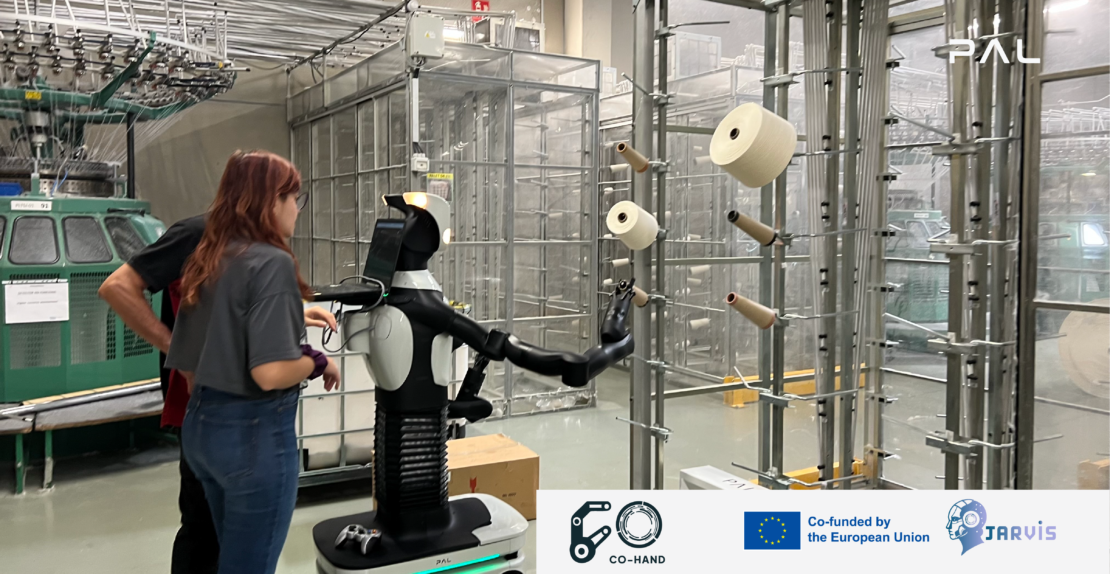
After two sprints of co-design, development and laboratory testing, the CO-HAND project, led by PAL Robotics in collaboration with CETRIKO, has completed its final phase. Part of the JARVIS Project, funded by the Horizon Europe programme, CO-HAND deployed and validated its integrated solution directly at CETRIKO’s textile factory in Barcelona during Sprint 3, reaching Technology Readiness Level 7.
The integrated system brought together all the capabilities developed throughout the project: the TIAGo Pro mobile manipulator with the custom adaptive gripper, integrated with the JARVIS/KUKA Object Recognition and Pose Estimation tool, autonomous navigation and the multi-modal Human-Robot Interaction interface combining a tablet-based WebGUI, LED signals and speech.
What was demonstrated
The trials at CETRIKO covered the main use cases defined for the pilot:
- Detection and handling of empty yarn cones, demonstrating the full perception-to-manipulation pipeline under real factory conditions.
- Manipulation of medium-weight cones of approximately 4 kg, including extraction, trajectory execution and controlled placement within the creel structure.
- Operator-in-the-loop supervision, with CETRIKO personnel initiating and monitoring tasks through the tablet interface and receiving real-time status feedback through LED signals.
The JARVIS/KUKA perception tool was validated as a key enabler of the workflow. By generating precise 3D grasping targets and reliably identifying the status of each cone slot, it contributed directly to the robustness and accuracy of the manipulation pipeline.
Human-robot interaction in a noisy industrial environment
The multimodal HRI approach proved effective during the operational trials. The mobile WebGUI enabled non-expert operators to initiate and supervise the main robot tasks without manual programming, while the LED signals provided clear and immediate information about the robot’s status. Both channels worked effectively in the factory environment.
Speech interaction was also implemented and available throughout the pilot. However, the high level of noise generated by the textile machinery limited its practical reliability. Voice interaction is therefore retained as a secondary or optional channel, while the mobile WebGUI and LED feedback are recommended as the primary interaction methods for this type of industrial deployment.
Lessons learned and next steps
One of the main lessons from CO-HAND is that effective industrial robotics cannot be developed solely in the laboratory. The continuous involvement of CETRIKO operators and production staff was essential for understanding how the technology would actually be used and for ensuring that development decisions responded to real workplace needs.
The co-design process began with on-site observation, interviews and requirements gathering, and continued through prototype reviews, operational trials and the final User Acceptance Test. This iterative approach allowed the project team to validate assumptions early, identify practical constraints and refine the solution throughout the development process.
The final validation therefore served not only to assess the completed system, but also to improve the technology through direct interaction with its intended users. Testing the solution in the real workplace revealed requirements and environmental factors that would have been difficult to reproduce fully in the laboratory.
CO-HAND demonstrates that co-design can reduce the risk of developing technically advanced solutions that do not fit existing workflows. By involving end users throughout the process, robotic systems can be made more usable, understandable and relevant, while technical development can be prioritised according to the areas that provide the greatest operational and ergonomic value.
Next steps include further optimisation of navigation for varying floor and environmental conditions, continued development of the gripper and manipulation pipeline for heavier cones, long-duration reliability testing and adaptation of the perception setup to different customer environments. The validated CO-HAND capabilities will also be explored for integration into PAL Robotics’ TIAGo Pro commercial package, with potential follow-up pilots in light manufacturing and intralogistics.
A validated path toward safer, more human-centred workplaces
CO-HAND demonstrates how mobile manipulation, AI-powered perception and intuitive human–robot interaction can be combined to support safer and more ergonomic industrial workplaces. By taking over selected repetitive lifting and high-reaching actions, the robot can reduce operators’ exposure to physically demanding tasks while preserving human supervision and decision-making.
Feedback from CETRIKO personnel was positive, particularly regarding the usability of the WebGUI, the clarity of the LED signals, perceived safety and the ease of learning how to use the system. During the final User Acceptance Test, participants indicated that they would be willing to use the robot in their daily work and that it could provide significant ergonomic relief.
The collaboration between PAL Robotics, CETRIKO and the JARVIS team provides a concrete example of how human–robot collaboration can be developed and validated within an Industry 5.0 framework: starting with workers’ needs, testing technology in its real operational context, and using the results to guide both technical maturation and future commercial deployment.
CO-HAND therefore provides a strong foundation for the continued development of collaborative mobile-manipulation solutions that place operator safety, usability and acceptance at the centre of industrial automation.
- EUProjects
- Humanoid
- Manipulation
- TIAGo Pro