The food-processing industry faces one of the greatest challenges in modern manufacturing: ensuring high productivity and quality in environments where tasks are diverse, repetitive and often physically demanding. Today, many operations still rely on manual handling, whether it’s moving boxes between production lines, feeding processing stations, or maintaining hygiene and traceability standards across facilities.
ROSALYA (Autonomous Robots in Logistics and Food Production) is redefining how automation can transform these processes. The project aims to develop intelligent mobile robots and mobile manipulators capable of handling logistics and manufacturing tasks that, until now, have been difficult, if not impossible, to automate. By combining mobile manipulation, intuitive human-robot interaction, environmental monitoring and 5G-enabled coordination, ROSALYA is laying the foundation for a new generation of flexible, safe and efficient robotics for the food industry.
PAL Robotics’ role and the platforms powering ROSALYA
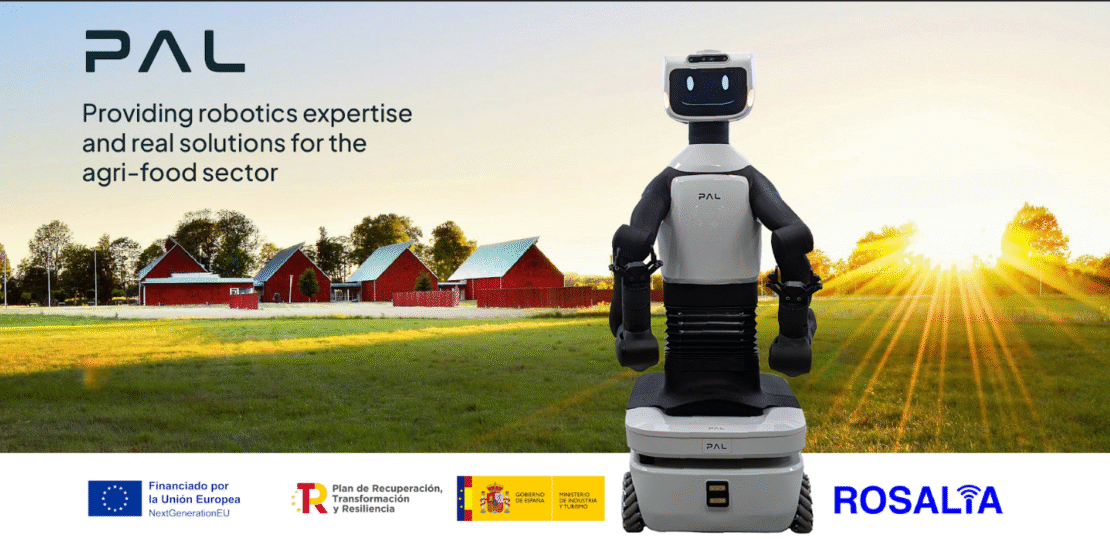
At the core of the project are PAL Robotics’ TIAGo Pro and TIAGo OMNI Base, two platforms that bring complementary strengths to the food-processing environment.
TIAGo Pro, with its omnidirectional base, torque-controlled arms and advanced perception capabilities, provides the manipulation intelligence required to automate complex tasks on the production floor.
TIAGo OMNI Base delivers autonomous, agile and reliable logistics, enabling point-to-point material flow in dynamic factory environments.
Together, these platforms allow ROSALYA to explore something that traditional industrial robots can’t: hybrid mobile robotics, where navigation, manipulation, perception and interaction come together in the same system. At PAL Robotics, we lead the integration of these technologies, developing the software, fleet-management logic, navigation strategies, perception pipelines and human-robot interaction capabilities that make them suitable for real agri-food applications.
Understanding the industry to design the right robotic processes
ROSALYA began with extensive field analysis at real production plants, where PAL Robotics and project partners mapped workflows, observed manual bottlenecks and identified the tasks where mobile manipulation and coordinated AMRs can provide the greatest impact.
This foundation is essential: it ensures that the technologies developed, ranging from mobile manipulators to 5G localisation, address real operational needs such as loading and unloading platforms, transferring materials between workstations and assisting in demanding tasks.
Advancing mobile manipulation for real production tasks
A central objective of ROSALYA is to bring robust manipulation onto mobile platforms. This unlocks automation in areas where fixed robots simply can’t reach or adapt. The project explores how a mobile manipulator can safely move through a factory, perceive its surroundings, and interact with products, containers and surfaces in a way that supports the work of human operators.
These capabilities enable a wide range of tasks: picking and placing products or packaging, transferring materials between work areas, loading and unloading items from mobile robots, supporting operators during repetitive handling, or performing precise spot-manufacturing actions that require dexterity. By validating these scenarios in the laboratory, we are building a roadmap toward real industrial deployment.
A step forward for the factories of tomorrow
As ROSALYA moves forward, the work being carried out with TIAGo Pro and TIAGo OMNI Base is steadily revealing what the next generation of factory automation might look like. Mobile robots that understand their surroundings, support workers, adapt to new tasks and communicate through natural interaction are no longer a distant vision, they are taking shape inside the project’s labs and pilot environments.What emerges is a new model of collaboration between people and robots, one where technology does not replace the expertise of operators but strengthens it. By giving robots the ability to navigate, manipulate, learn and communicate, ROSALYA opens the door to safer, more flexible and more resilient food-processing facilities.
- Agri-food
- Collaborative
- Logistics