Robots have made significant progress in recent years. They can move with precision, interact with people and follow instructions expressed in natural language. But today’s main challenge is not agility or dexterity, it is the ability to perform a task correctly even when conditions change.
This challenge becomes especially visible in service environments. Take hospitality as an example. Hotel rooms vary constantly, objects are moved and people interact with the space at all times. For a robot, operating in this context requires more than accurate motion. It requires understanding what needs to be done and adapting actions accordingly.
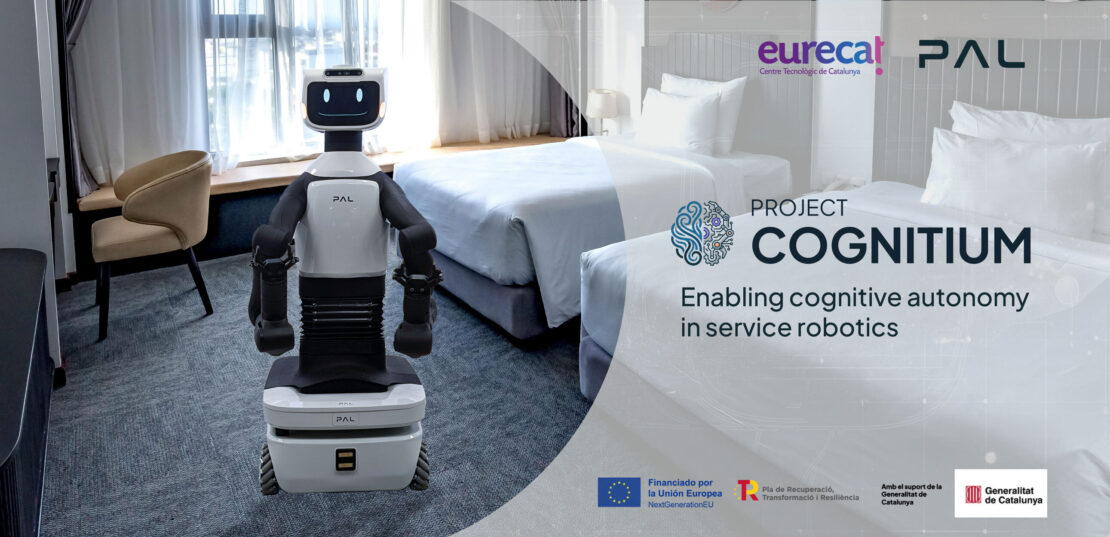
It is within this context that COGNITIUM takes shape. The project, led by PAL Robotics in collaboration with Eurecat, aims to advance the cognitive capabilities of service robotics. Built on the TIAGo Pro platform, COGNITIUM focuses on enabling autonomous operation in highly variable environments, using hospitality as its validation domain.
From research to deployments: COGNITIUM’s objectives
The core objective of COGNITIUM is to develop an advanced robotic platform capable of progressing from Technology Readiness Level (TRL) 3-4 to TRL 5 by the end of the project. This includes a functional demonstration in a hotel room setting, where the robot must execute tasks based on natural language instructions.
Rather than relying on task-specific automation, the project focuses on autonomy grounded in understanding. The robot is expected to interpret instructions, reason about its surroundings and execute physical actions safely and effectively. This reflects a broader shift in robotics, from scripted behaviour to platforms that adapt to changing conditions.
A hybrid cognitive architecture for service robots
At the heart of COGNITIUM lies a hybrid cognitive architecture that combines generative artificial intelligence with symbolic planning. Generative models enable the robot to process language and visual information, while symbolic planning provides structure, coherence and control over decision-making.
The project integrates vision-language models and vision-language-action models to connect perception, reasoning and execution. This allows the robot to translate instructions into concrete actions, adapting its behaviour to context rather than following fixed sequences.
A key objective is to reduce dependence on external technologies and move toward systems that are interpretable, reliable and adaptable, essential qualities for service robots operating alongside people.
From understanding to action: cognitive execution
Cognitive reasoning alone is not sufficient for effective operation in real-world service environments. COGNITIUM therefore places strong emphasis on execution and control, ensuring that high-level decision-making is consistently translated into safe and reliable physical behaviour. To achieve this, the project focuses on learning and validating actions in conditions that reflect the complexity and variability of service scenarios. Data is gathered through physical task execution and simulation, providing the basis for refining the action models for manipulation and movement.
Simulation environments play a central role in this process, enabling systematic testing of behaviours and validation of strategies before deployment in real settings. The system is integrated using ROS 2, ensuring modularity and alignment with current robotics software standards.
This approach allows the robot to adapt its actions based on context and perception, rather than relying on predefined motion sequences.
Built in Europe, designed for real applications
Beyond technical goals, COGNITIUM contributes to the European technological landscape. The project develops and validates advanced robotics technologies built locally, aligned with European regulatory and cultural frameworks and accessible to industry and society.
By fostering collaboration between industry and research centres, the project accelerates technology transfer and lays the groundwork for future applications beyond hospitality, including healthcare, assisted living and facility management.
Through this approach, COGNITIUM brings cognitive robotics one step closer to everyday service environments.
- EUProjects
- TIAGo Pro